
There is a lot of chat in running at the moment. Motion control shoes versus strength and conditioning, carbon plates, insoles, gait analysis on a shop treadmill. Most of it misses the point, because the wider problem I see, year after year, is people throwing money at a problem rather than fixing what needs to be fixed first. And what needs fixing first, almost every time, is how they run.
Run form is where most of the speed is lost and most of the injuries are made, and almost nobody works on it, because it is not for sale. That is my coaching view, and I will be straight with you about where the research backs it up and where it is simply what I see.
What does good run form look like?
Good form is not complicated. The body is tall through the hips, not folded at the waist. The foot lands underneath you (beneath your centre of mass), not out in front. The step is quick and light rather than long and heavy. There is very little bounce, so the effort goes forward instead of up. And the lower leg is strong enough to take the landing and drive the push off without a shoe doing it for you.
It can all be built, and one lever moves nearly everything else at once. I have been prescribing cadence work since the day I started coaching, and I still have not found anything that gives a runner more for less. To my mind it is the first and most important lever within run form, for speed, for staying out of the physio's waiting room, and for stopping your form falling apart in the last hour of a race.
What does cadence actually change?
Cadence is just the number of steps you take per minute. Change it at a fixed speed and the stride has to change with it, because speed is cadence multiplied by stride length. Quicken the step and three things happen. The foot lands closer to underneath you (beneath your centre of mass), you bounce less, and you brake less.
This has been measured properly. When 45 recreational runners ran at the same speed with their cadence raised 5 and 10 per cent above their natural rate, step length shortened, the up and down travel of their centre of mass dropped, braking impulse dropped, and the energy absorbed at the knee and hip fell. Drop the cadence 10 per cent and every joint absorbed substantially more (Heiderscheit et al., 2011). A systematic review of ten such studies found the same picture: less vertical movement, lower ground reaction force, less shock, and less energy absorbed at the hip, knee and ankle (Schubert, Kempf and Heiderscheit, 2014), with lower peak loading on the glutes during landing too (Lenhart, Thelen and Heiderscheit, 2014).
In plainer words: better cadence means lower vertical oscillation, less braking force on every step, and less force going up through the body. The effort goes forward instead of up and down.
Why do bouncing and braking cost you?
Two reasons: economy and injury.
Lower vertical oscillation is one of the technique factors most consistently linked with better running economy (Moore, 2016). In the biggest study of its kind, 97 runners were filmed on a treadmill, and three measures, how much the pelvis moved up and down during ground contact, how much the knee bent, and how much the runner slowed on landing, between them explained 39 per cent of the variation in energy cost, with braking also tied to season's best time (Folland et al., 2017). Land out in front and you hit the brakes on every step, and a heel striker in shoes generates a markedly larger collision force than a barefoot forefoot striker (Lieberman et al., 2010).
Then there is injury. Over a season of high school cross country, runners in the lowest cadence group, 164 steps per minute or fewer, had more than six times the odds of picking up a shin injury compared with those at 174 and above (Luedke et al., 2016). In runners with knee pain, a single session with a metronome lifting step rate by 10 per cent improved their mechanics, pain and function, and they were running further pain free three months later (Bramah et al., 2019).
I do need to be honest on one point. The lab has not crowned cadence the king of running speed. Moore's review notes that most runners naturally settle on a stride length close to their most economical, with only small deviations, up to around 3 per cent shorter, doing any good. So if you are already efficient, a big cadence change will not make you instantly faster. What I see is that very few amateurs are. The runners who come to me at 155 to 165 have a lot of room, and the reduction in load arrives in week one whatever the economy numbers do.
What happens when you get tired?
This is where cadence earns its keep, and where my view was formed, at the roadside in the back half of marathons, Ironmans and ultras.
When fatigue arrives, cadence drifts down. In 179 runners filmed at 8 km and again at 40 km of a marathon, everyone slowed, cadence fell, ground contact time went up by 13 per cent, and the knee bent less in support (Chan-Roper et al., 2012). At the very top, filming the World Championship marathons showed step length and cadence both falling between 29.5 km and 40 km, and the authors concluded that training the fatigue resistance of the key muscles and tendons matters more than which part of the foot you land on (Hanley, Bissas and Merlino, 2020).
Here is the pattern I see, and this is my observation rather than a published finding. The lower your cadence is to begin with, the steeper that late-race decline tends to be. If you start a marathon at 155 to 160 and fade to 140, you are effectively sitting down in your run form. The hips drop, the foot reaches out, every landing is a brake, and your body is fighting forward movement with every step. If you start at 180 and fade to 175, you are still running well. Same fatigue, different outcome.
The best ultra runners do something different, and I think it proves the same point from the other direction. Elite runners in a 100 km World Championship averaged 182 steps per minute and, once you allowed for speed, their cadence did not drop with fatigue at all (Burns, Zendler and Zernicke, 2019), and over a 24 hour treadmill run experienced ultra runners actually quickened their step by around 5 per cent and landed with lower peak forces (Morin, Samozino and Millet, 2011). The people who can run for a day keep the step short and quick when everything else is failing. The rest of us have to train it in.
Is 180 the magic number?
The number comes from Jack Daniels (not the whiskey maker), who counted the steps of the runners at the 1984 Olympics, from the 800 m to the marathon, and found that almost all of them were at 180 or more (Daniels, 2014). It was a floor for elites, not a prescription, and the 100 km runners above ranged from 155 to 203, with taller runners sitting lower (Burns, Zendler and Zernicke, 2019).
So I treat 180 as a target, not a law. What I ask my athletes to do is lock in 180 steps per minute at mid to high zone 2, the easy aerobic running that makes up most of their week. Do that, and you will likely see 185 to 195 at tempo and in efforts without trying, because cadence rises with speed, by roughly 5 to 6 steps per minute for every metre per second of pace in the 100 km data (Burns, Zendler and Zernicke, 2019). With a quick step as your base, going faster means applying more force, pushing off harder, or both. Without it, going faster means reaching the leg out and lengthening the stride, which turns running into a strength activity: overstriding, heel striking, a jolt through the foot, and a brake on every step.
Why not just buy a more supportive shoe?
Because if you focus on strength, you do not need the motion control shoe. The foot does that job for you. That is the whole of my argument, and here is why I believe it.
A motion control shoe exists to stop the arch collapsing inwards under load. But you already own something built for exactly that. Tibialis posterior, the muscle that runs down the inside of the shin and under the arch, is the primary dynamic stabiliser of the medial arch in gait (Semple et al., 2009). Underneath it sits the foot core, the small intrinsic muscles that control the arch the way the deep trunk muscles control the spine, and the people who proposed that model pointed out that treatment for foot problems usually goes straight to supporting the foot from the outside rather than training those muscles (McKeon et al., 2015). Above both sits the calf, taking the landing and driving the push off. Strong and working together, that system controls pronation from the inside. A shoe does it from the outside, and a foot that has its job done for it never gets any stronger.
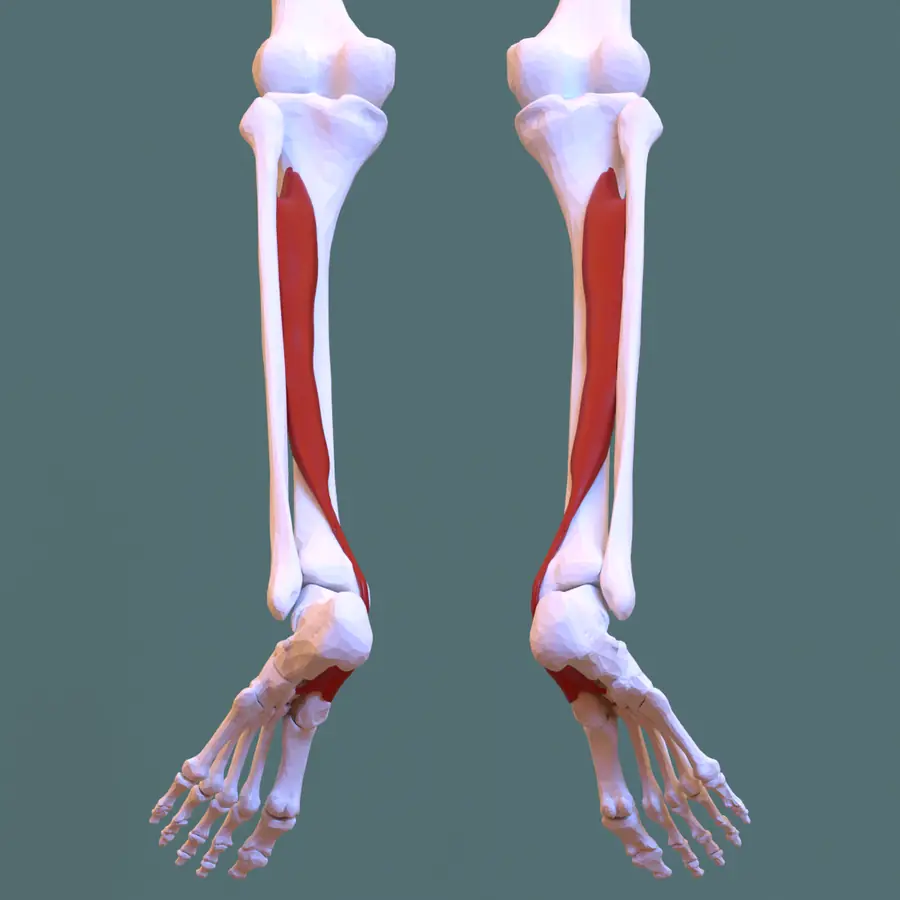
Train the system and it changes, measurably. Four weeks of the short foot exercise, which is simply learning to draw the arch up without curling the toes, reduced navicular drop, how far the arch collapses under weight, by around 2 mm and improved single leg balance (Mulligan and Cook, 2013). That is the foot doing the shoe's job. In a year long randomised trial, recreational runners who followed an eight week foot and ankle strengthening programme and kept it going had a 2.4 fold lower rate of running injuries than the controls (Taddei et al., 2020). For tibialis posterior itself, progressive resistance work improved pain and function in early tendon problems beyond what orthoses alone managed (Kulig et al., 2009).
Now the honest part. The research does say that motion control shoes can help a pronated runner. In the one large blinded trial on the subject, 372 recreational runners were given a standard or a motion control version of the same shoe, and the motion control group had fewer injuries over six months, with the benefit concentrated in runners with pronated feet (Malisoux et al., 2016). If you are injured right now I am not telling you to throw your shoes away. The wider evidence for prescribing shoes by foot type is thin, though. A review looking for trials to support it found none (Richards, Magin and Callister, 2009), a trial that randomised women runners to neutral, stability or motion control shoes found the motion control shoe produced more pain (Ryan et al., 2011), and one of the best-known footwear researchers has argued that impact and pronation were never the injury predictors the industry assumed (Nigg et al., 2015).
So my position is a coaching choice, and I will own it as one. The shoe can help in the short term, but it does nothing to make you stronger. I would rather build the foot that does not need it, and in my experience, once an athlete has done a few months of the strength work, they stop asking which shoe will fix them. One warning: do not run in minimal shoes overnight. When experienced runners switched to barefoot style shoes over ten weeks, more than half showed new bone stress in the feet on MRI (Ridge et al., 2013).
How do I build cadence?
Patiently. Tendons and calves need weeks, not days.
- Measure first. Most watches show it. Note your natural number on a few easy runs.
- Go up in steps of 5 to 10 per cent, never more. That is what the lab used (Heiderscheit et al., 2011). From 160, aim for 168 to 172, hold it for two to three weeks until it feels normal, then go again. The goal is 180 at mid to high zone 2.
- Use the metronome on your watch. Most run watches have one built in, Garmin certainly does, and it is the tool the knee pain study used (Bramah et al., 2019). Do not set it to 180. Set it to beep once every other footfall, 90 beeps a minute, because that is far easier to follow than something chirping 180 times a minute. Pick a foot, right or left, land that foot on the beep, and stay in sync with it.
- Think short and quick, not fast. Shorter stride, feet landing underneath you (beneath your centre of mass), light and quiet. The cue I give is to imagine the knee leading the stride rather than the foot; the foot then lands where it should without you thinking about it. Your easy pace should not change; if it does, you have sped up rather than quickened.
- At tempo and in efforts, let it rise. 185 to 195 is normal once 180 is your easy day baseline. If your hard running sits at 175, that is overstriding.
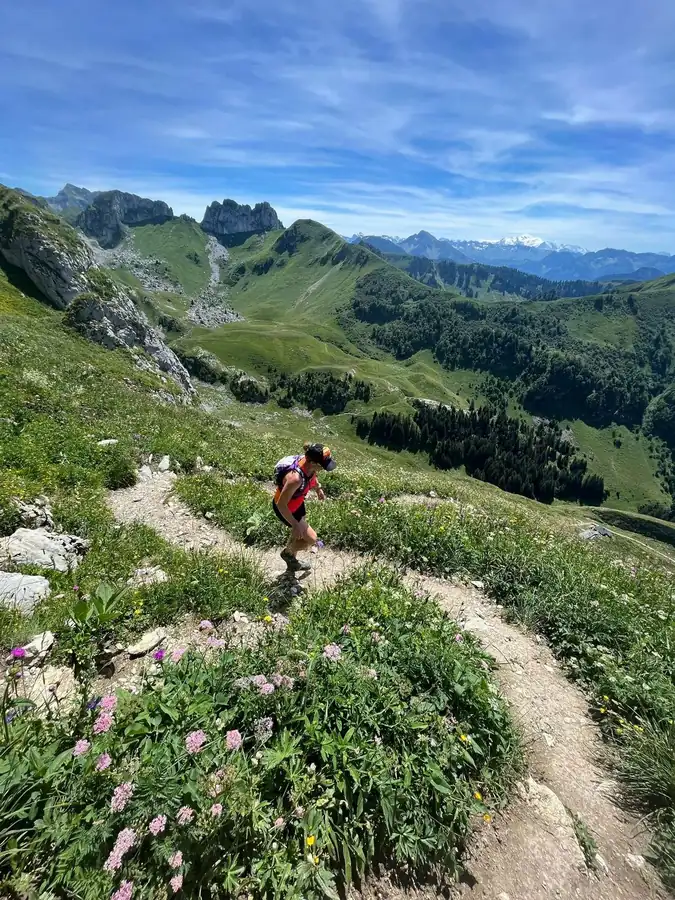
- Hills are the test. Keep the step quick going up, shorten it going down. Uphill is where cadence goes first, downhill is where braking bites.
What strength work goes with it?
Cadence protects you from load, but you still need a lower leg that can take what is left. I target the tibialis posterior, the calf and the foot, because between them they hold the arch, control the landing and drive the push off.
- Tibialis posterior. The muscle I see weak most often in runners who have lived in supportive shoes. The exercise that hits it most selectively is resisted foot adduction: sat down, band around the forefoot anchored to the outside, draw the foot inwards against the band and slowly back out, two to three sets of 15 to 20 (Kulig et al., 2004).
- Calf. Single leg heel raises, straight knee and bent knee, slow on the way down, building to loaded. Straight knee works the gastrocnemius, bent knee the soleus, and the heel raise recruits tibialis posterior as well (Kulig et al., 2004). Three sets of 12 to 15, twice a week.
- Foot core. The short foot exercise: standing, draw the ball of the big toe back towards the heel to lift the arch without curling the toes, hold five seconds, repeat (McKeon et al., 2015; Mulligan and Cook, 2013). Add single leg balance barefoot.
- Walk in less shoe. Walking in minimal shoes, step count built up week by week, grew foot muscle size and strength as much as a formal exercise programme (Ridge et al., 2019). Walking, not running, until the foot has earned it.
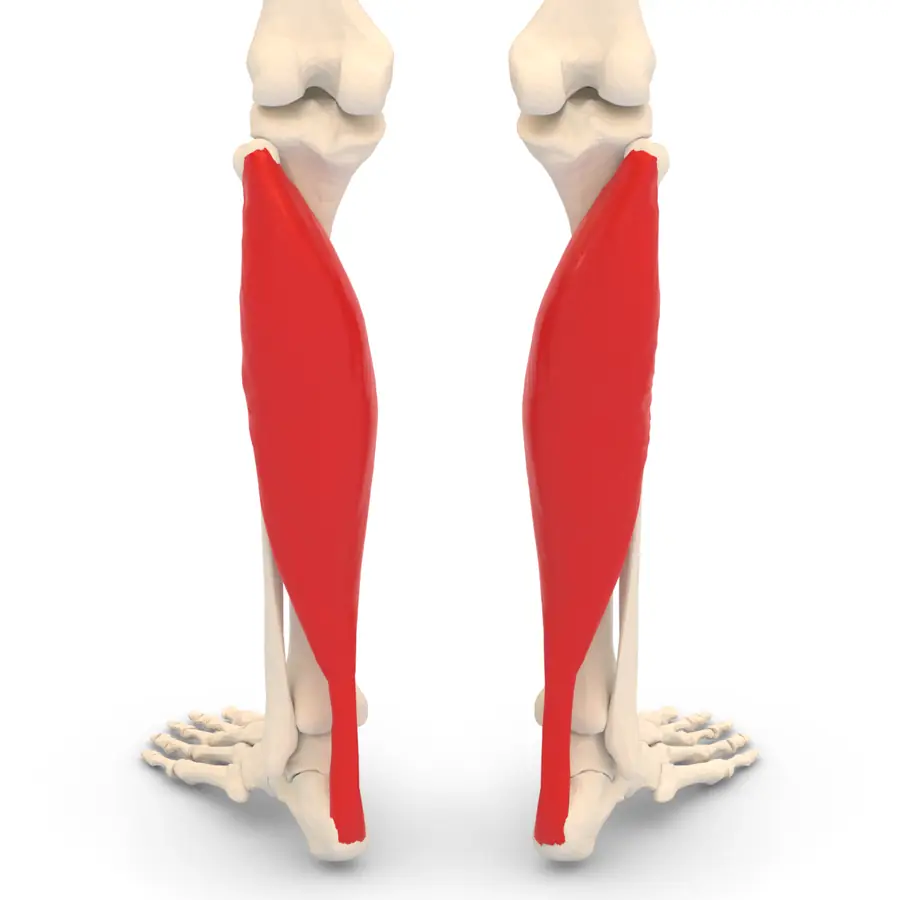
A word on the soleus, because most runners have never heard of it. It is the flat muscle under the gastrocnemius, and in my experience it develops once you start landing properly on the midfoot. The mechanics support that: land on the forefoot or midfoot instead of the heel and the work shifts from the knee to the ankle, with higher plantarflexor moments and more force through the Achilles (Kulmala et al., 2013; Stearne et al., 2014). That load is the training stimulus, and the reason to change your landing gradually.
None of this needs a gym. Ten minutes, three times a week, for a few months, is the dose.
The short version
Fix the form before you buy the fix. Quicken your step. Get to 180 at easy pace in steps of 5 to 10 per cent, with a metronome or a watch alert, and let it rise when you run hard. You will bounce less, brake less, and put less through your knees and hips on every stride, and when the fatigue arrives late in the race you will have somewhere to fade from. Strengthen the tibialis posterior, the calf and the foot so the leg can carry the load, and let the foot do its job before you pay a shoe to do it instead.
If you want this built into your training properly, with the cadence targets, the strength work and the running planned together, start with Block Coaching, where I build your plan block by block, or come and find me on Coached by Tom if you want me in your corner for all of it. Either way, go and count your steps.
References
Bramah, C., Preece, S.J., Gill, N. and Herrington, L. (2019) 'A 10% increase in step rate improves running kinematics and clinical outcomes in runners with patellofemoral pain at 4 weeks and 3 months', American Journal of Sports Medicine, 47(14), pp. 3406-3413.
Burns, G.T., Zendler, J.M. and Zernicke, R.F. (2019) 'Step frequency patterns of elite ultramarathon runners during a 100-km road race', Journal of Applied Physiology, 126(2), pp. 462-468.
Chan-Roper, M., Hunter, I., Myrer, J.W., Eggett, D.L. and Seeley, M.K. (2012) 'Kinematic changes during a marathon for fast and slow runners', Journal of Sports Science and Medicine, 11(1), pp. 77-82.
Daniels, J. (2014) Daniels' Running Formula. 3rd edn. Champaign, IL: Human Kinetics.
Folland, J.P., Allen, S.J., Black, M.I., Handsaker, J.C. and Forrester, S.E. (2017) 'Running technique is an important component of running economy and performance', Medicine and Science in Sports and Exercise, 49(7), pp. 1412-1423.
Hanley, B., Bissas, A. and Merlino, S. (2020) 'Men's and women's World Championship marathon performances and changes with fatigue are not explained by kinematic differences between footstrike patterns', Frontiers in Sports and Active Living, 2, p. 102.
Heiderscheit, B.C., Chumanov, E.S., Michalski, M.P., Wille, C.M. and Ryan, M.B. (2011) 'Effects of step rate manipulation on joint mechanics during running', Medicine and Science in Sports and Exercise, 43(2), pp. 296-302.
Kulig, K., Burnfield, J.M., Requejo, S.M., Sperry, M. and Terk, M. (2004) 'Selective activation of tibialis posterior: evaluation by magnetic resonance imaging', Medicine and Science in Sports and Exercise, 36(5), pp. 862-867.
Kulig, K., Reischl, S.F., Pomrantz, A.B., Burnfield, J.M., Mais-Requejo, S., Thordarson, D.B. and Smith, R.W. (2009) 'Nonsurgical management of posterior tibial tendon dysfunction with orthoses and resistive exercise: a randomized controlled trial', Physical Therapy, 89(1), pp. 26-37.
Kulmala, J.P., Avela, J., Pasanen, K. and Parkkari, J. (2013) 'Forefoot strikers exhibit lower running-induced knee loading than rearfoot strikers', Medicine and Science in Sports and Exercise, 45(12), pp. 2306-2313.
Lenhart, R., Thelen, D. and Heiderscheit, B. (2014) 'Hip muscle loads during running at various step rates', Journal of Orthopaedic and Sports Physical Therapy, 44(10), pp. 766-774.
Lieberman, D.E., Venkadesan, M., Werbel, W.A., Daoud, A.I., D'Andrea, S., Davis, I.S., Mang'eni, R.O. and Pitsiladis, Y. (2010) 'Foot strike patterns and collision forces in habitually barefoot versus shod runners', Nature, 463(7280), pp. 531-535.
Luedke, L.E., Heiderscheit, B.C., Williams, D.S. and Rauh, M.J. (2016) 'Influence of step rate on shin injury and anterior knee pain in high school runners', Medicine and Science in Sports and Exercise, 48(7), pp. 1244-1250.
Malisoux, L., Chambon, N., Delattre, N., Gueguen, N., Urhausen, A. and Theisen, D. (2016) 'Injury risk in runners using standard or motion control shoes: a randomised controlled trial with participant and assessor blinding', British Journal of Sports Medicine, 50(8), pp. 481-487.
McKeon, P.O., Hertel, J., Bramble, D. and Davis, I. (2015) 'The foot core system: a new paradigm for understanding intrinsic foot muscle function', British Journal of Sports Medicine, 49(5), p. 290.
Moore, I.S. (2016) 'Is there an economical running technique? A review of modifiable biomechanical factors affecting running economy', Sports Medicine, 46(6), pp. 793-807.
Morin, J.B., Samozino, P. and Millet, G.Y. (2011) 'Changes in running kinematics, kinetics, and spring-mass behavior over a 24-h run', Medicine and Science in Sports and Exercise, 43(5), pp. 829-836.
Mulligan, E.P. and Cook, P.G. (2013) 'Effect of plantar intrinsic muscle training on medial longitudinal arch morphology and dynamic function', Manual Therapy, 18(5), pp. 425-430.
Nigg, B.M., Baltich, J., Hoerzer, S. and Enders, H. (2015) 'Running shoes and running injuries: mythbusting and a proposal for two new paradigms: "preferred movement path" and "comfort filter"', British Journal of Sports Medicine, 49(20), pp. 1290-1294.
Richards, C.E., Magin, P.J. and Callister, R. (2009) 'Is your prescription of distance running shoes evidence-based?', British Journal of Sports Medicine, 43(3), pp. 159-162.
Ridge, S.T., Johnson, A.W., Mitchell, U.H., Hunter, I., Robinson, E., Rich, B.S. and Brown, S.D. (2013) 'Foot bone marrow edema after a 10-wk transition to minimalist running shoes', Medicine and Science in Sports and Exercise, 45(7), pp. 1363-1368.
Ridge, S.T., Olsen, M.T., Bruening, D.A., Jurgensmeier, K., Griffin, D., Davis, I.S. and Johnson, A.W. (2019) 'Walking in minimalist shoes is effective for strengthening foot muscles', Medicine and Science in Sports and Exercise, 51(1), pp. 104-113.
Ryan, M.B., Valiant, G.A., McDonald, K. and Taunton, J.E. (2011) 'The effect of three different levels of footwear stability on pain outcomes in women runners: a randomised control trial', British Journal of Sports Medicine, 45(9), pp. 715-721.
Schubert, A.G., Kempf, J. and Heiderscheit, B.C. (2014) 'Influence of stride frequency and length on running mechanics: a systematic review', Sports Health, 6(3), pp. 210-217.
Semple, R., Murley, G.S., Woodburn, J. and Turner, D.E. (2009) 'Tibialis posterior in health and disease: a review of structure and function with specific reference to electromyographic studies', Journal of Foot and Ankle Research, 2, p. 24.
Stearne, S.M., Alderson, J.A., Green, B.A., Donnelly, C.J. and Rubenson, J. (2014) 'Joint kinetics in rearfoot versus forefoot running: implications of switching technique', Medicine and Science in Sports and Exercise, 46(8), pp. 1578-1587.
Taddei, U.T., Matias, A.B., Duarte, M. and Sacco, I.C.N. (2020) 'Foot core training to prevent running-related injuries: a survival analysis of a single-blind, randomized controlled trial', American Journal of Sports Medicine, 48(14), pp. 3610-3619.
Tom Cooling coaches endurance athletes at Horsepower Coaching. This piece is written from his coaching experience and the research cited, and is general guidance, not a substitute for individual coaching, physiotherapy or medical advice.
Train with Horsepower
If that is how you like your coaching, straight and built for your race, take a look at the training plans or see how coaching works.