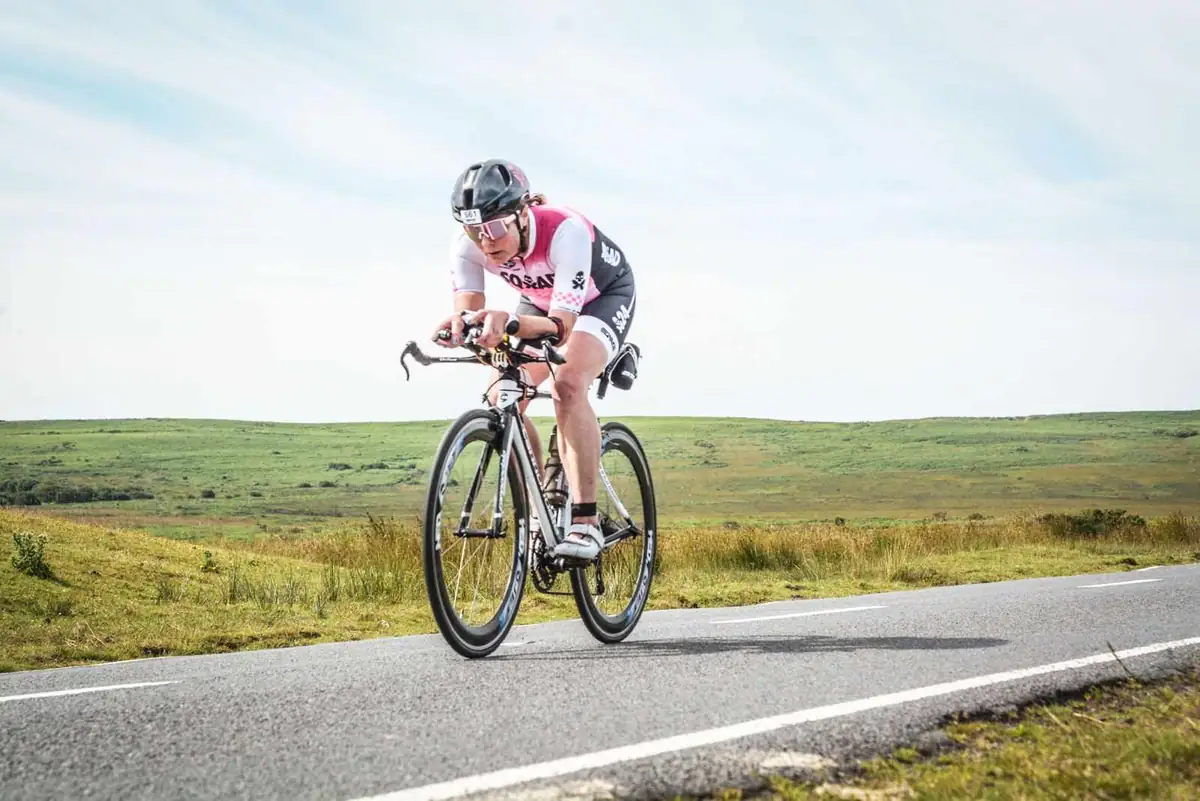
Most training plans are built for a man and then shrunk. Fewer hours, lighter weights, softer targets, same physiology underneath. That's female-adapted, and it's lazy coaching. I do it the other way round. The female athlete is the default, not the exception, and that decision runs through everything from how the plan is built to how I read the sessions that come back.
What does "female-first" actually mean?
It means the plan is designed for a female body from the first line, rather than a male template with the numbers turned down. Menstrual cycle, hormonal context, symptom load, life load, the lot, treated as things that matter, not a disclaimer at the bottom of the page.
I coach a small roster of women who race at the front, and they're the proof I trust more than any brochure. Hannah S won Ironman Wales in 2022. Madison S won it in 2025. Naomi S and Elly B have podiums and wins across some of the hardest races going. I keep the full list of what these women have done on my female performance page, and every line of it comes straight off their race results. Those are results, not marketing, and the coaching behind them is female-first because the athletes are.
Should women train around their menstrual cycle?
This is where a lot of the noise in the sport overclaims, so I want to be honest about what the evidence supports and what it doesn't.
The headline claim you see everywhere, "train hard in the follicular phase, back off in the luteal phase," isn't well supported. The largest synthesis we've got, the McNulty et al. 2020 meta-analysis, found that the effect of menstrual cycle phase on exercise performance is small, and on average close to trivial. More importantly, the response is highly individual. Some women are genuinely flattened in the days before their period; others notice almost nothing; a few feel strongest at points a rigid model would tell them to rest.
So a plan that hard-codes "smash the follicular phase" is selling a certainty the science doesn't have. If the average effect is small and the individual variation is large, then the coaching answer isn't a fixed prescription. It's to track the individual.
So what's the actual win?
Two things, and neither of them is phase-prescription.
Symptom management. The performance shift across the cycle may be small, but the symptoms are real and they're what actually derails sessions: cramps, heavy bleeding, sleep disruption, migraine, gut trouble, the flat low-motivation days. Coaching that helps an athlete plan her quality work around her own symptom pattern, adjust fuelling and hydration, and stop treating a bad-symptom day as a fitness failure, is worth far more than a colour-coded phase chart.
Closing the education gap. Surveys of female athletes repeatedly find that a large majority, roughly seven in ten, report their cycle affects their training, yet under a third have ever been given any education on how to work with it. That gap is the real problem. The voices worth reading here are the honest ones: Emma Ross and the well+ team, Georgie Bruinvels, Kirsty Elliott-Sale. They don't oversell. They teach women to understand their own response and make decisions from it, which is exactly the job.
How I actually coach it
Cycle-aware, not cycle-deterministic. If an athlete wants to log her cycle and her symptoms, that becomes one input among several, alongside sleep, life stress, how the last block has gone and what we're trying to build, that I use to decide whether today's a day to push or a day to protect. I don't lock a woman out of a hard session because a chart thinks she's in the "wrong" phase. I look at what her body is actually telling us, put it in context, and explain the call I've made. Athlete-trusted, coach-led.
What does female-first change beyond the cycle?
The cycle gets the headlines, but treating the female athlete as the default changes a lot of quieter decisions too. Fuelling is one. Under-fuelling is common in endurance sport and the consequences are more serious for women, because chronic low energy availability disrupts hormonal function and bone health in ways a male template will never flag. A female-first plan treats adequate fuelling as non-negotiable, and it doesn't quietly reward the under-eating that a lot of the sport still celebrates.
Strength work is another. It's not a bolt-on for women, it's central, for bone density, for durability, for injury resistance and for raw performance, and a female-first plan protects it rather than dropping it the moment the schedule gets tight. And life load matters. Many of the women I coach are balancing training with careers and caring responsibilities that don't pause for a training block, so the plan has to bend around real weeks without treating a missed session as a moral failure. None of that's exotic. It's just what coaching looks like when the female athlete is who you designed for from the start.
Is female-first only for elite women?
No. The palmares is the sharp end, the proof the method holds up against the best fields going. But the same principles, honest cycle-awareness, proper fuelling, protected strength work, a plan that bends around a real life, matter just as much for the woman training for her first sportive or her first half-distance triathlon. Arguably they matter more there, because she's the one least likely to have ever been coached this way.
The short version
Female-first is a design decision, not a marketing line. The cycle matters, but it matters through symptoms and individual response, not through a rigid "train hard now, rest now" rule the evidence can't back. Track the individual, manage the symptoms, close the education gap, and coach the woman in front of me. That's the whole method, and if you want to see how it plays out, it's all on the female performance page.
Train with Horsepower
If that is how you like your coaching, straight and built for your race, take a look at the training plans or see how coaching works.